Wednesday, April 18, 2007

New book release: The Qur’an and Sayings of Prophet Muhammad


Dear family, friends, and colleagues
Assalamu’alaykum,

Hope this note finds you and your family well. By the grace of God, I am happy to announce that my new book, “The Qur’an and Sayings of Prophet Muhammad: Selections Annotated & Explained,” has been released and is now available for purchase. I would like to thank all of you for your friendship and support as I wrote this book and hope you will enjoy reading it as much as I enjoyed writing it.
If you enjoy the read, please consider writing an amazon.com review and spreading the word among your friends. A full description follows below. Many thanks and peace, Sohaib.
The Qur’an and Sayings of Prophet Muhammad: Selections Annotated & Explained
Sohaib N. Sultan
http://www.skylightpaths.com/Merchant2/merchant.mvc?Screen=PROD&Store_Code=SP&Product_Code=978-1-59473-222-5

Book Description
For many in the West, the teachings of the Qur'an often are enshrouded in mystery and fear. Yet Islam's holy book gave birth to one of the most powerful and enlightened civilizations the world has ever seen. By the sixteenth century, Muslim culture stretched from India to Africa to Europe , preserving with it the ancient learning that helped spawn the Renaissance. With its interwoven ideas of faith and reason, justice and mercy, the path of Islam--which literally means "surrendering to God's will"--offers a uniquely focused and balanced approach to living life with a profound awareness of God.

With gentleness and insight, Sohaib N. Sultan leads you through the central themes of both the Qur'an and the collected sayings of Prophet Muhammad, known as hadith. These teachings dispel common misconceptions about Muslim beliefs and offer practical guidance for your own spiritual journey, from understanding the merciful nature of God; to cultivating peace and justice in the self, family, and society; to answering questions about the afterlife and how to attain it.

Now you can experience the wisdom of Qur'anic teachings even if you have no previous knowledge of Islam or Muslim writings. Insightful yet unobtrusive facing-page commentary explains the texts for you, allowing you to enter into the path of surrender to God.


Scott C. Alexander, PhD, associate professor of Islam and director of Catholic-Muslim Studies, Catholic Theological Union
"A superb guide ... intelligently illuminates each thematically arranged passage and concisely summarizes centuries of Islamic interpretive wisdom."

Michael Wolfe, author of The Hadj: An American's Pilgrimage to Mecca
"Lays before us ... the insights and beauty of one of the world's great sacred texts. A valuable book for any reader who honestly wants to understand the Qur'an and what it teaches."

Rev. Steven Blackburn, PhD, Duncan Black Macdonald Center for the Study of Islam and Christian-Muslim Relations
"Takes complex, wide-ranging aspects of Islam and makes them clear and accessible for the non-Muslim and Muslim alike. Comes alive with thoughtfully presented insights and reflections. Whether you have a passing interest in Islam, or have serious questions about this community of faith, you will want to consult [this book]."

About the Author
Sohaib N. Sultan is the author of The Koran for Dummies. In 2005, he was appointed as the first-ever Muslim chaplain at Yale University , and now serves as a Muslim chaplain at Trinity College and Wesleyan University . He is a freelance journalist and public speaker.

Thursday, March 29, 2007

Islam in Conversation Week : Wesleyan April 9-13


MSA and Chaplains Office at Wesleyan presents

Islam in Conversation Week:
Dialogue Through the Arts

April 9-13th, 2007

Wesleyan University * Middletown, CT 06459


Everyone is cordially invited to attend and participate in what promises to be an enlightening and educational week of films, lectures, conversations, and performances on Muslim life, culture, and experience. Our presenters, who are as international as China and as local as Hartford, come to us with diverse backgrounds as award winning filmmakers, respected scholars, and world renowned calligrapher. Please bring your friends and spread the word!


~~~~~~~~~~~~~~~~~~~~~
Monday, April 9: Window into American Muslim Life
Fisk Hall 302 (262 High St), 7pm

A short film, A Sons Sacrifice, follows the journey of Imran, a young American Muslim who struggles to take over his father's halal slaughterhouse in New York City. A first-generation American, Imran must confront his mixed heritage and gain acceptance from his father's immigrant community at the traditional storefront slaughterhouse. On the holiest day of the year, Imran must lead a sacrifice that will define him as a Muslim, as an American, and as a son. [www.sonsacrifice.com].

Conversation with co-producers Musa Syeed and Yoni Brook, award winning filmmakers, will follow the screening of this film.

~~~~~~~~~~~~~~~~~~~~~
Tuesday, April 10: Exposing Bias: Islamaphobia in the Media
Russell House (350 High St), 6pm

Lecture by Omer Bajwa on his groundbreaking masters thesis at Cornell University on media portrayals of Islam and Muslims.

~~~~~~~~~~~~~~~~~~~~~
Wednesday, April 11: Critical Analysis: Sunni-Shia Relations in the Media
Public Affairs Center 002 (238 Church St), 7pm

Depictions of Sunni-Shia relations in the media, distinguishing facts from fiction. Conversation with a Sunni, Suendam Birinci, and a Shia, Ayat Agah, from the highly prestigious Hartford Seminary.

~~~~~~~~~~~~~~~~~~~~~
Thursday, April 12: A Muslim Filmmaker's Search for Dialogue and Peace
Public Affairs Center 004 (238 Church St), 7pm

Lecture by Alex Kronemer, an award winning filmmaker and scholar of comparative religion. Kronemer is the other co-producer of Muhammad: Legacy of a Prophet, and the upcoming films Cities of Light: The Rise and Fall of Islamic Spain, and Prince Among Slaves. [www.upf.tv]

~~~~~~~~~~~~~~~~~~~~~
Friday, April 13: Photo Essay of Islam in China
Russell House (350 High St), 4:15pm

Rare insight into a marvelous history, place, and people with world-renowned
Chinese master calligrapher, Haji Noor Deen.

~~~~~~~~~~~~~~~~~~~~~
Friday April 13: Praise in Ink: The Art of Islamic Calligraphy
Russell House (350 High St), 7:30pm

Lecture and art demonstration on Islamic calligraphy by world-renowned Chinese Muslim master calligrapher, Haji Noor Deen, on the rich tradition of art and beauty in Islam. This is your chance to learn from a great artist and to purchase his artwork.


Questions? Contact Sohaib Sultan at snsultan@wesleyan.edu or 860.685.2285.

Wesleyan University * Middletown, CT 06459


Monday, September 11, 2006

Radio Interview

Here is a link to my interview on the Bruce and Colin Show, CBS radio. (WTIC/Talk 1080: Hartford, CT).

The archived audio show is available in 2 separate clips under the 'Recent Episodes' column on the left side of the page: http://wtic.com/pages/5478.php?

Colin McEnroe with Sohaib Sultan: Part I
Colin McEnroe with Sohaib Sultan: Part II

Enjoy and please send me your feedback!

archived show::
[part 1]
[part 2]

Saturday, September 09, 2006

The Value of Time

My dear brothers and sisters, there is one aspect of life if used wisely will give us success in this world and the hereafter, and if used foolishly will give us loss in this world and in the hereafter. Verily, this is time, for in the words of the great Egyptian scholar, Hasan Al Banna, “Time is life itself.” In other words, the very quality of our lives is determined by the way in which we use our time. If we spend most of our time merely enjoying ourselves and pleasing our lower desires, then life itself will be useless, unproductive, and no better than the life of cattle; and we will return to our Lord with nothing but unfulfilled promises and potential. But, if we spend much of our time in devotion to Allah (swt) and doing good deeds, then our very living will be worthwhile, beneficial, and dignified; and we will return to our Lord joyous, having fulfilled the purpose of life.

This is why Allah (swt) says in the Qur’an, “By time, verily man is in a state of loss! Except those who believe, and do good deeds, and practice patience, and practice truth.” And so, the only way that we can make time a friend rather than an enemy is if we use time for increasing in faith, doing good works, practicing patience, and practicing the truth.

In the words of hujjat al-Islam, Imam Al-Ghazali, “[Time] is nothing other than your life, and your life is the capital that you make use of to reach perpetual felicity in the proximity of Allah (swt).”

So, what are some practical steps that we can take to make better use of our time:

First, we simply need to become more conscious of the passing of time and how we use our time. We draw again from the wisdom of Imam Al-Ghazali who said, “Each of your breaths is a priceless jewel, since each of them is irreplaceable and, once gone, can never be retrieved.” And it is only by developing this type of an internal consciousness of time that we can move towards a more effective use of the limited time we have in this world. It is only when we guard time like a sacred jewel that we can truly make use of it.

Secondly, we must identify and recognize the priorities of life and divide our time by giving equal attention to each of those priorities. The Prophet Muhammad (s) said that a believer’s time should be divided into three parts: One part for rest, relaxation, and enjoyment; another part for working and earning a living; and another part for devotion to Allah. And the Prophet (s) warned against extremism in any part of life to the exclusion of another, saying that our bodies have a right over us, our souls have a right over us, and our families have a right over us. So, we must carefully examine the priorities of life in order to structure our time accordingly.

Thirdly, we must make a daily schedule for ourselves and strictly abide by it taking into consideration all of the worldly and religious obligations we have. Again, drinking from the ocean of Imam Al-Ghazali’s wisdom, he says, “You should not neglect your time or use it haphazardly; on the contrary, you should bring yourself to account, structure your devotions and other practices during each day and night, and assign to each period a fixed and specific function. This is how to bring out the spiritual blessing [baraka] in each period. But if you leave yourself adrift, aimlessly wandering as cattle do, not knowing how to occupy yourself at every moment, your time will be lost.” So, make a daily schedule and guard your time as you would guard a priceless jewel.

Lastly, constantly remind yourself that time can end without a moments notice, and that none of us are guaranteed a long life or good health to make use of our time. The Prophet (s) once took Umar (ra) by the shoulder and said, “Live in this world as if you were a wayfarer or a traveler.” And Umar (ra) used to add, “If you live till the morning, do not except to live till the evening, and if you live till the evening do not except to live till the night.” In doing so, a believer is more careful with his or her time and hastens to make good use of whatever remaining time they have left in the world.

In conclusion, my brothers and sisters, time is indeed the capital of our life, and only time well spent will allow us to draw nearer to our Lord and to taste success in this world and in the hereafter. As such, we must guard our time by becoming more aware of the way we spend it, by giving priority to the important things in life, by following a strict schedule that structures our lives, and by recognizing the fact that time is bound to end sooner or later for each one of us, and in the end we must all return to Allah to answer the essential question: “How did you spend your life?” The answer to this question will be determined by how use our time.

May Allah (swt) give us the wisdom to use our time wisely during this academic year and throughout our lives, and May Allah (swt) grant us full and virtuous lives so that we may be successful in this world and in the hereafter. O Allah! Make us among the wise who spent their time wisely in this world, and not among the fools who spent their time foolishly in this world.

Monday, August 28, 2006

Civic Engagment

My dear brothers and sisters, this American Muslim community of ours is a historical community livening in historic times. We are a community that is the wealthiest of all Muslim communities per capita, and the most educated and literate Muslim community per capita. And we live in undoubtedly the most powerful and influential country in the world today, and the world’s only remaining superpower. As such, we American Muslims have a special opportunity, a special duty and obligation, to see to it that this nation of ours, whether we are residents or citizens of it, is steered in the right direction—a direction that appeals to the highest ethical and moral conscience, and not the highest paying lobbyist. A direction that appeals to this country’s founding principles of “justice and liberty for all”, and not the corrupt principle of “might makes right.”

However, we cannot fulfill this special duty and obligation by sitting idly in our homes and complaining about the direction of this country, or by sitting around and offering one conspiracy theory after another, or by making lofty speeches about peace and justice in Islam.

Rather, the only way we can fulfill our special duty and responsibility as servants of Allah is to actively participate in what is good, and forbidding what is evil. Allah (swt) says in surat-al-Imran, "Let there be a community among you who call to the good, and enjoin the right, and forbid the wrong. For they are the ones who have success." And the Prophet Muhammad said, 'Whoever of you sees something wrong should change it with his hand; if he cannot, then with his tongue; if he cannot, then with his heart, and that is the weakest form of belief.”


So what the Qur’an and Sunnah teach us is that we must actively participate in civic engagement, and work, and strive for the divinely enjoined objectives of justice, fairness, equality, and peace in this world. And, therefore as an American Muslim community we must make social justice and human rights the corner stone of our community, and a part and parcel of our very identity. In order to do this, we must rise above our current level or discourse that is whinny and conspiratorial in nature, to a more sophisticated and enlightened discourse that appeals to the morally conscious soul and to the intellectually gifted mind.

And in order to do this, we must, as a community, learn how to write, how to speak, how to influence policy makers in local and national politics, and how to build coalitions so that we may be more effective in enjoining the right and forbidding the wrong. This requires not only a study of the Islamic sciences, but also a study of history, politics, sociology, and all other sciences that influence the decision making of this country. For example, if we want to appeal to policymakers in this country on behalf of our oppressed brothers and sisters in Palestine, we must remind them of this country’s founding principles on foreign relations, which was articulated by the United States first president, George Washington in his farewell address of 1796, in which he said:

“Observe good faith and justice toward all nations. Cultivate peace and harmony with all. Religion and morality enjoin this conduct. And can it be that good policy does not equally enjoin it?”

“… A passionate attachment of one nation for another produces a variety of evils. Sympathy for the favorite nation, facilitating the illusion of an imaginary common interest in cases where no real common interest exists, and infusing into one the enmities of the other, betrays the former into a participation in the quarrels and wars of the latter without adequate inducement or justification. It leads also to concessions to the favorite nation of privileges denied to others, which is apt doubly to injure the nation making the concessions by unnecessarily parting with what ought to have been retained, and by exciting jealousy, ill will, and a disposition to retaliate in the parties from whom equal privileges are withheld.”


“Verily, Allah will never change the condition of a people until they change what is within themselves.”

Rain as a sign of Allah

وَمِنْ آيَاتِهِ يُرِيكُمُ الْبَرْقَ خَوْفًا وَطَمَعًا وَيُنَزِّلُ مِنَ السَّمَاء مَاء فَيُحْيِي بِهِ الْأَرْضَ بَعْدَ مَوْتِهَا إِنَّ فِي ذَلِكَ لَآيَاتٍ لِّقَوْمٍ يَعْقِلُونَ

My dear brothers and sisters, one of the greatest challenges that believers have faced throughout time is whispers of doubt regarding either the existence of Allah or some or some of the qualities that Allah possesses or a denial of the Day of Judgment and the afterlife. In this age in particular some of these arguments have become more sophisticated with the use of scientific theories, such as the theory of evolution, which many atheists site in their defense of atheism.

As such, it is imperative for Muslims today to strengthen their sense of belief and certainty in the existence of Allah, and the qualities of our Sustainer, and in the reality that one day we will face accountability for our deeds in this world.

In fact, Imam Al-Haddad, who was a scholar and a mystic in 17th century Yemen, and is considered by many to have been the mujaddid, or renewer of the twelfth Islamic century, wrote a famous book by title of “The Book of Assistance.” In this book, Imam Al-Haddad begins with certainty [qaeen] as the first and foremost quality that a believer must possess in order to live a good and virtous life.

However, Allah does not expect us to have blind faith without any signs or proofs. And this is why Imam Al-Haddad in prescribing medicine to gain certainty, one of the things he mentions is that certainty is gained by “looking at the kingdom of the heavens and the earth, and the wondrous and astounding creatures that God made them flourish with.” And the proof of this is in the words of Allah:


“We shall show them Our signs on the horizons and within themselves until it becomes clear to them that this is the Truth. Is it not enough that your Sustainer is a witness over all things?”


As such, the Qur’an is filled with signs of Allah and constantly encourages us to observe the creation in order to remove any doubts from our hearts. Interestingly, given the season of rain that we are in these days, one of the most often used signs for the existence of Allah, and metaphors for the qualities of Allah, can be found in rain and thunder.


As proof of the existence of Allah, the Qur’an says:


24:43 Art thou not aware that it is God who causes the clouds to move onward, then joins them together, then piles them up in masses, until thou can see rain come forth from their midst? And He it is who sends down from the skies, by degrees, mountainous masses [of clouds] charged with hail, striking therewith whomever He wills and averting it from whomever He wills, [the while] the flash of His lightning well-nigh deprives [men of their] sight!


36:33 And [yet,] they have a sign [of Our power to create and to resurrect] in the lifeless earth which We make alive, and out of which We bring forth grain, whereof they may eat; 36:34 and [how] We make gardens of date-palms and vines [grow] thereon, and cause springs to gush [forth] within it, 36:35 so that they may eat of the fruit thereof, though it was not their hands that made it. Will they not, then, be grateful? 36:36 Limitless in His glory is He who has created opposites in whatever the earth produces, and in men’s own selves, and in that of which [as yet] they have no knowledge.

And as a sign for the ability of Allah to bring decaying bones back to life for resurrection the Qur’an again uses the metaphor of rain.


32:27 Are they not aware that it is We who drive the rain onto dry land devoid of herbage, and thereby bring forth herbage of which their cattle and they themselves do eat? Can they not, then, see [the truth of resurrection]?

And Allah also uses the rain to remind us of His divine Mercy and compassion towards the creation.


42:28 And it is He who sends down rain after [men] have lost all hope, and unfolds His grace [thereby]: for He alone is [their] Protector, the One to whom all praise is due.

50:9 And We send down from the skies water rich in blessings, and cause thereby gardens to grow, and fields of grain. 50:10 and tall palm-trees with their thickly-clustered dates, 50:11 as sustenance appor­tioned to men; and by [all] this We bring dead land to life: [and] even so will be [man’s] coming-forth from death.

Rain is such a powerful metaphor that Allah also uses it for reminding us of divine wrath and punishment that comes upon a people who reject Allah and persist in wrongdoings.


25:40 And they [who now deny Our messages] must surely have come across that town which was rained upon by a rain of evil: have they, then, never beheld it [with their minds eye]? But nay, they would not believe in resurrection!

2:19 Or [the parable] of a violent cloudburst in the sky, with utter darkness, thunder and lightning: they put their fingers into their ears to keep out the peals of thunder, in terror of death; but God encompasses [with His might] all who deny the truth.

And in conclusion,


10:24 The parable of the life of this world is but that of rain which We send down from the sky, and which is absorbed by the plants of the earth whereof men and animals draw nourishment, until -when the earth has assumed its artful adornment and has been embellished, and they who dwell on it believe that they have gained mastery over it -there comes down upon it Our judgment, by night or by day, and We cause it to become [like] a field mown down, as if there had been no yesterday. Thus clearly do We spell out these messages unto people who think!

So, let’s use this sometimes difficult and frightening season of rain to remind ourselves of the proof of Allah’s existence, in His Mercy, in His punishment, and in the day of resurrection where will to answer how did we live our lives. And in doing this let us strengthen our inner certainty for in the words of Imam Al-Haddad, “certainty is the essential thing, and all other noble ranks, praiseworthy traits of character and good works are its branches and results.” And in the words of the Prophet (s), “Certainty is the whole of faith.”

Our Role as Ambassadors of Islam


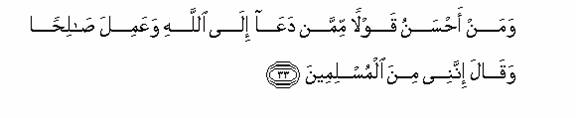
Who is better in speech than one who invites to Allah, and does righteous deeds, and says, “I am of those who submit to the will of Allah.”

CBS Poll:

What is your impression of Islam?

In 2002, 30% said their impression of Islam was favorable, and 33% said their impression of Islam was unfavorable. In other words, the country was about split on their perception of Islam less than a year after September 11th.

Now, according to the CBS poll in April of this year, only 19% say they have a favorable impression of Islam, and 45% say that they have an unfavorable perception of Islam.

These statistics, and there are others that come to the same conclusion, may be due to a whole host of factors from media bias to Middle East crisis in which Muslims are often designated the role of bad guys. However, one inescapable reality that is reflected in this poll is the fact that we, as a collective community, have not done enough or have done very little to educate our fellow Americans of Islam’s true message, and of Islam’s gift to humanity. And this poll also indicates that we have not found the right techniques and methodology for integrating a positive image of Islam into the hearts and minds of the American people.

Therefore it is our responsibility, both as individuals and as a community, to go out and tell people through our words and deeds of Islam’s real message of mercy, kindness, and justice for all of Allah’s creation. Allah says in surah Fussilat, ayah 33: “Who is better in speech than one who invites to Allah, and does righteous deeds, and says, “I am of those who submit to the will of God.”

And in order to effectively invite people to Islam and to educate people about Islam we must see ourselves as ambassadors of Allah and His Messenger (s). And a good ambassador must possess the following qualities:

He or she must possess wholesome knowledge on the subject.

He or she must know how to convey this knowledge in a way that is accurate and easy to understand.

He or she must possess the wisdom to answer difficult questions or respond to difficult situations.

He or she must be an embodiment for the values for which he or she is an ambassador.