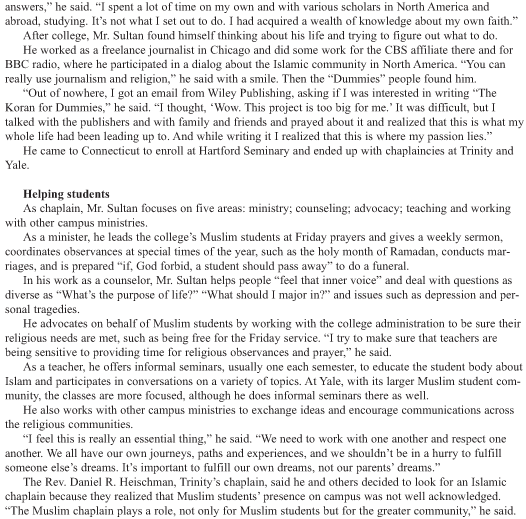
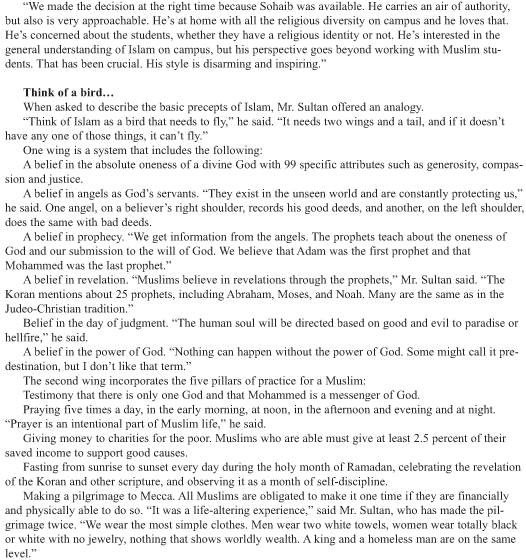
Here is a link to my interview on the Bruce and Colin Show, CBS radio. (WTIC/Talk 1080: Hartford, CT).
The archived audio show is available in 2 separate clips under the 'Recent Episodes' column on the left side of the page: http://wtic.com/pages/5478.php?
Colin McEnroe with Sohaib Sultan: Part I
Colin McEnroe with Sohaib Sultan: Part II
Enjoy and please send me your feedback!
archived show::
[part 1]
[part 2]
Monday, September 11, 2006

Saturday, September 09, 2006
The Value of Time
My dear brothers and sisters, there is one aspect of life if used wisely will give us success in this world and the hereafter, and if used foolishly will give us loss in this world and in the hereafter. Verily, this is time, for in the words of the great Egyptian scholar, Hasan Al Banna, “Time is life itself.” In other words, the very quality of our lives is determined by the way in which we use our time. If we spend most of our time merely enjoying ourselves and pleasing our lower desires, then life itself will be useless, unproductive, and no better than the life of cattle; and we will return to our Lord with nothing but unfulfilled promises and potential. But, if we spend much of our time in devotion to Allah (swt) and doing good deeds, then our very living will be worthwhile, beneficial, and dignified; and we will return to our Lord joyous, having fulfilled the purpose of life.
This is why Allah (swt) says in the Qur’an, “By time, verily man is in a state of loss! Except those who believe, and do good deeds, and practice patience, and practice truth.” And so, the only way that we can make time a friend rather than an enemy is if we use time for increasing in faith, doing good works, practicing patience, and practicing the truth.
In the words of hujjat al-Islam, Imam Al-Ghazali, “[Time] is nothing other than your life, and your life is the capital that you make use of to reach perpetual felicity in the proximity of Allah (swt).”
So, what are some practical steps that we can take to make better use of our time:
First, we simply need to become more conscious of the passing of time and how we use our time. We draw again from the wisdom of Imam Al-Ghazali who said, “Each of your breaths is a priceless jewel, since each of them is irreplaceable and, once gone, can never be retrieved.” And it is only by developing this type of an internal consciousness of time that we can move towards a more effective use of the limited time we have in this world. It is only when we guard time like a sacred jewel that we can truly make use of it.
Secondly, we must identify and recognize the priorities of life and divide our time by giving equal attention to each of those priorities. The Prophet Muhammad (s) said that a believer’s time should be divided into three parts: One part for rest, relaxation, and enjoyment; another part for working and earning a living; and another part for devotion to Allah. And the Prophet (s) warned against extremism in any part of life to the exclusion of another, saying that our bodies have a right over us, our souls have a right over us, and our families have a right over us. So, we must carefully examine the priorities of life in order to structure our time accordingly.
Thirdly, we must make a daily schedule for ourselves and strictly abide by it taking into consideration all of the worldly and religious obligations we have. Again, drinking from the ocean of Imam Al-Ghazali’s wisdom, he says, “You should not neglect your time or use it haphazardly; on the contrary, you should bring yourself to account, structure your devotions and other practices during each day and night, and assign to each period a fixed and specific function. This is how to bring out the spiritual blessing [baraka] in each period. But if you leave yourself adrift, aimlessly wandering as cattle do, not knowing how to occupy yourself at every moment, your time will be lost.” So, make a daily schedule and guard your time as you would guard a priceless jewel.
Lastly, constantly remind yourself that time can end without a moments notice, and that none of us are guaranteed a long life or good health to make use of our time. The Prophet (s) once took Umar (ra) by the shoulder and said, “Live in this world as if you were a wayfarer or a traveler.” And Umar (ra) used to add, “If you live till the morning, do not except to live till the evening, and if you live till the evening do not except to live till the night.” In doing so, a believer is more careful with his or her time and hastens to make good use of whatever remaining time they have left in the world.
In conclusion, my brothers and sisters, time is indeed the capital of our life, and only time well spent will allow us to draw nearer to our Lord and to taste success in this world and in the hereafter. As such, we must guard our time by becoming more aware of the way we spend it, by giving priority to the important things in life, by following a strict schedule that structures our lives, and by recognizing the fact that time is bound to end sooner or later for each one of us, and in the end we must all return to Allah to answer the essential question: “How did you spend your life?” The answer to this question will be determined by how use our time.
May Allah (swt) give us the wisdom to use our time wisely during this academic year and throughout our lives, and May Allah (swt) grant us full and virtuous lives so that we may be successful in this world and in the hereafter. O Allah! Make us among the wise who spent their time wisely in this world, and not among the fools who spent their time foolishly in this world.
This is why Allah (swt) says in the Qur’an, “By time, verily man is in a state of loss! Except those who believe, and do good deeds, and practice patience, and practice truth.” And so, the only way that we can make time a friend rather than an enemy is if we use time for increasing in faith, doing good works, practicing patience, and practicing the truth.
In the words of hujjat al-Islam, Imam Al-Ghazali, “[Time] is nothing other than your life, and your life is the capital that you make use of to reach perpetual felicity in the proximity of Allah (swt).”
So, what are some practical steps that we can take to make better use of our time:
First, we simply need to become more conscious of the passing of time and how we use our time. We draw again from the wisdom of Imam Al-Ghazali who said, “Each of your breaths is a priceless jewel, since each of them is irreplaceable and, once gone, can never be retrieved.” And it is only by developing this type of an internal consciousness of time that we can move towards a more effective use of the limited time we have in this world. It is only when we guard time like a sacred jewel that we can truly make use of it.
Secondly, we must identify and recognize the priorities of life and divide our time by giving equal attention to each of those priorities. The Prophet Muhammad (s) said that a believer’s time should be divided into three parts: One part for rest, relaxation, and enjoyment; another part for working and earning a living; and another part for devotion to Allah. And the Prophet (s) warned against extremism in any part of life to the exclusion of another, saying that our bodies have a right over us, our souls have a right over us, and our families have a right over us. So, we must carefully examine the priorities of life in order to structure our time accordingly.
Thirdly, we must make a daily schedule for ourselves and strictly abide by it taking into consideration all of the worldly and religious obligations we have. Again, drinking from the ocean of Imam Al-Ghazali’s wisdom, he says, “You should not neglect your time or use it haphazardly; on the contrary, you should bring yourself to account, structure your devotions and other practices during each day and night, and assign to each period a fixed and specific function. This is how to bring out the spiritual blessing [baraka] in each period. But if you leave yourself adrift, aimlessly wandering as cattle do, not knowing how to occupy yourself at every moment, your time will be lost.” So, make a daily schedule and guard your time as you would guard a priceless jewel.
Lastly, constantly remind yourself that time can end without a moments notice, and that none of us are guaranteed a long life or good health to make use of our time. The Prophet (s) once took Umar (ra) by the shoulder and said, “Live in this world as if you were a wayfarer or a traveler.” And Umar (ra) used to add, “If you live till the morning, do not except to live till the evening, and if you live till the evening do not except to live till the night.” In doing so, a believer is more careful with his or her time and hastens to make good use of whatever remaining time they have left in the world.
In conclusion, my brothers and sisters, time is indeed the capital of our life, and only time well spent will allow us to draw nearer to our Lord and to taste success in this world and in the hereafter. As such, we must guard our time by becoming more aware of the way we spend it, by giving priority to the important things in life, by following a strict schedule that structures our lives, and by recognizing the fact that time is bound to end sooner or later for each one of us, and in the end we must all return to Allah to answer the essential question: “How did you spend your life?” The answer to this question will be determined by how use our time.
May Allah (swt) give us the wisdom to use our time wisely during this academic year and throughout our lives, and May Allah (swt) grant us full and virtuous lives so that we may be successful in this world and in the hereafter. O Allah! Make us among the wise who spent their time wisely in this world, and not among the fools who spent their time foolishly in this world.
Monday, August 28, 2006
Civic Engagment
My dear brothers and sisters, this American Muslim community of ours is a historical community livening in historic times. We are a community that is the wealthiest of all Muslim communities per capita, and the most educated and literate Muslim community per capita. And we live in undoubtedly the most powerful and influential country in the world today, and the world’s only remaining superpower. As such, we American Muslims have a special opportunity, a special duty and obligation, to see to it that this nation of ours, whether we are residents or citizens of it, is steered in the right direction—a direction that appeals to the highest ethical and moral conscience, and not the highest paying lobbyist. A direction that appeals to this country’s founding principles of “justice and liberty for all”, and not the corrupt principle of “might makes right.”
However, we cannot fulfill this special duty and obligation by sitting idly in our homes and complaining about the direction of this country, or by sitting around and offering one conspiracy theory after another, or by making lofty speeches about peace and justice in Islam.
“Verily, Allah will never change the condition of a people until they change what is within themselves.”
Rain as a sign of Allah
وَمِنْ آيَاتِهِ يُرِيكُمُ الْبَرْقَ خَوْفًا وَطَمَعًا وَيُنَزِّلُ مِنَ السَّمَاء مَاء فَيُحْيِي بِهِ الْأَرْضَ بَعْدَ مَوْتِهَا إِنَّ فِي ذَلِكَ لَآيَاتٍ لِّقَوْمٍ يَعْقِلُونَ
My dear brothers and sisters, one of the greatest challenges that believers have faced throughout time is whispers of doubt regarding either the existence of Allah or some or some of the qualities that Allah possesses or a denial of the Day of Judgment and the afterlife. In this age in particular some of these arguments have become more sophisticated with the use of scientific theories, such as the theory of evolution, which many atheists site in their defense of atheism.
As such, it is imperative for Muslims today to strengthen their sense of belief and certainty in the existence of Allah, and the qualities of our Sustainer, and in the reality that one day we will face accountability for our deeds in this world.
In fact, Imam Al-Haddad, who was a scholar and a mystic in 17th century
However, Allah does not expect us to have blind faith without any signs or proofs. And this is why Imam Al-Haddad in prescribing medicine to gain certainty, one of the things he mentions is that certainty is gained by “looking at the kingdom of the heavens and the earth, and the wondrous and astounding creatures that God made them flourish with.” And the proof of this is in the words of Allah:
“We shall show them Our signs on the horizons and within themselves until it becomes clear to them that this is the Truth. Is it not enough that your Sustainer is a witness over all things?”
As such, the Qur’an is filled with signs of Allah and constantly encourages us to observe the creation in order to remove any doubts from our hearts. Interestingly, given the season of rain that we are in these days, one of the most often used signs for the existence of Allah, and metaphors for the qualities of Allah, can be found in rain and thunder.
As proof of the existence of Allah, the Qur’an says:
24:43 Art thou not aware that it is God who causes the clouds to move onward, then joins them together, then piles them up in masses, until thou can see rain come forth from their midst? And He it is who sends down from the skies, by degrees, mountainous masses [of clouds] charged with hail, striking therewith whomever He wills and averting it from whomever He wills, [the while] the flash of His lightning well-nigh deprives [men of their] sight!
36:33 And [yet,] they have a sign [of Our power to create and to resurrect] in the lifeless earth which We make alive, and out of which We bring forth grain, whereof they may eat; 36:34 and [how] We make gardens of date-palms and vines [grow] thereon, and cause springs to gush [forth] within it, 36:35 so that they may eat of the fruit thereof, though it was not their hands that made it. Will they not, then, be grateful? 36:36 Limitless in His glory is He who has created opposites in whatever the earth produces, and in men’s own selves, and in that of which [as yet] they have no knowledge.
And as a sign for the ability of Allah to bring decaying bones back to life for resurrection the Qur’an again uses the metaphor of rain.
32:27 Are they not aware that it is We who drive the rain onto dry land devoid of herbage, and thereby bring forth herbage of which their cattle and they themselves do eat? Can they not, then, see [the truth of resurrection]?
And Allah also uses the rain to remind us of His divine Mercy and compassion towards the creation.
42:28 And it is He who sends down rain after [men] have lost all hope, and unfolds His grace [thereby]: for He alone is [their] Protector, the One to whom all praise is due.
50:9 And We send down from the skies water rich in blessings, and cause thereby gardens to grow, and fields of grain. 50:10 and tall palm-trees with their thickly-clustered dates, 50:11 as sustenance apportioned to men; and by [all] this We bring dead land to life: [and] even so will be [man’s] coming-forth from death.
Rain is such a powerful metaphor that Allah also uses it for reminding us of divine wrath and punishment that comes upon a people who reject Allah and persist in wrongdoings.
25:40 And they [who now deny Our messages] must surely have come across that town which was rained upon by a rain of evil: have they, then, never beheld it [with their minds eye]? But nay, they would not believe in resurrection!
2:19 Or [the parable] of a violent cloudburst in the sky, with utter darkness, thunder and lightning: they put their fingers into their ears to keep out the peals of thunder, in terror of death; but God encompasses [with His might] all who deny the truth.
And in conclusion,
10:24 The parable of the life of this world is but that of rain which We send down from the sky, and which is absorbed by the plants of the earth whereof men and animals draw nourishment, until -when the earth has assumed its artful adornment and has been embellished, and they who dwell on it believe that they have gained mastery over it -there comes down upon it Our judgment, by night or by day, and We cause it to become [like] a field mown down, as if there had been no yesterday. Thus clearly do We spell out these messages unto people who think!
So, let’s use this sometimes difficult and frightening season of rain to remind ourselves of the proof of Allah’s existence, in His Mercy, in His punishment, and in the day of resurrection where will to answer how did we live our lives. And in doing this let us strengthen our inner certainty for in the words of Imam Al-Haddad, “certainty is the essential thing, and all other noble ranks, praiseworthy traits of character and good works are its branches and results.” And in the words of the Prophet (s), “Certainty is the whole of faith.”
Our Role as Ambassadors of Islam
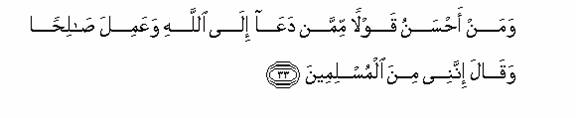
Who is better in speech than one who invites to Allah, and does righteous deeds, and says, “I am of those who submit to the will of Allah.”
CBS Poll:
What is your impression of Islam?
In 2002, 30% said their impression of Islam was favorable, and 33% said their impression of Islam was unfavorable. In other words, the country was about split on their perception of Islam less than a year after September 11th.
Now, according to the CBS poll in April of this year, only 19% say they have a favorable impression of Islam, and 45% say that they have an unfavorable perception of Islam.
These statistics, and there are others that come to the same conclusion, may be due to a whole host of factors from media bias to Middle East crisis in which Muslims are often designated the role of bad guys. However, one inescapable reality that is reflected in this poll is the fact that we, as a collective community, have not done enough or have done very little to educate our fellow Americans of Islam’s true message, and of Islam’s gift to humanity. And this poll also indicates that we have not found the right techniques and methodology for integrating a positive image of Islam into the hearts and minds of the American people.
Therefore it is our responsibility, both as individuals and as a community, to go out and tell people through our words and deeds of Islam’s real message of mercy, kindness, and justice for all of Allah’s creation. Allah says in surah Fussilat, ayah 33: “Who is better in speech than one who invites to Allah, and does righteous deeds, and says, “I am of those who submit to the will of God.”
And in order to effectively invite people to Islam and to educate people about Islam we must see ourselves as ambassadors of Allah and His Messenger (s). And a good ambassador must possess the following qualities:
He or she must possess wholesome knowledge on the subject.
He or she must know how to convey this knowledge in a way that is accurate and easy to understand.
He or she must possess the wisdom to answer difficult questions or respond to difficult situations.
He or she must be an embodiment for the values for which he or she is an ambassador.
Biography
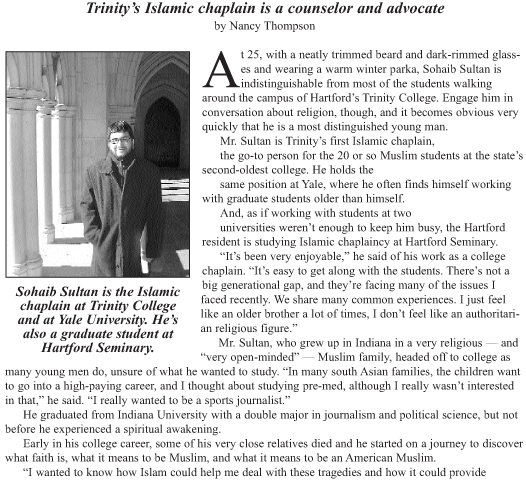
Sohaib Nazeer Sultan is the first full-time Muslim Life Coordinator and Chaplain at Princeton University.
Sultan is a graduate of the Hartford Theological Seminary earning a Masters in Islamic Studies & Christian-Muslim Relations, and a Graduate Certificate in Islamic Chaplaincy. His research and academic interests are in Islamic spirituality and psychology, as well as the development of practical skills in religious leadership. Sultan's master's thesis was entitled Preaching with Purpose: Writing and Delivering Great Sermons.
Sultan is a well-known author and writer. His first book, “The Koran for Dummies,” part of the well-known for Dummies series was published by Wiley Publishing Inc. in 2004. Sultan published his second book with Skylight Paths Publishing, “The Qur’an and Sayings of Prophet Muhammad: Selection Annotated and Explained,” in 2007. He is also the author of several published articles and continues to write for various publications.
Sultan is also a public lecturer on Islam, Muslim Cultures, and Muslim-Western Relations. He has traveled all around the U.S., the Middle East, and Europe to promote mutual respect and understanding.
Currently, Sultan lives in Hamilton, New Jersey with his wife, who is also a very active part of Muslim life on campus.
At Princeton University, Sultan is available throughout the academic year as a resource for students seeking faith-based counseling or advice. He also welcomes questions and conversations about Islam and Muslim practices.
Sultan’s office is located on the 2nd floor of Murray-Dodge Hall. To make an appointment, email ssultan@princeton.edu or call 609.258.3042.
Subscribe to:
Posts (Atom)
